Whispers Beneath the Interface: How Regional Customs Quietly Reshape Support Exchanges and Payment Flows in Digital Gaming Spaces
Written by Quinn Lange · Jun 19, 2026
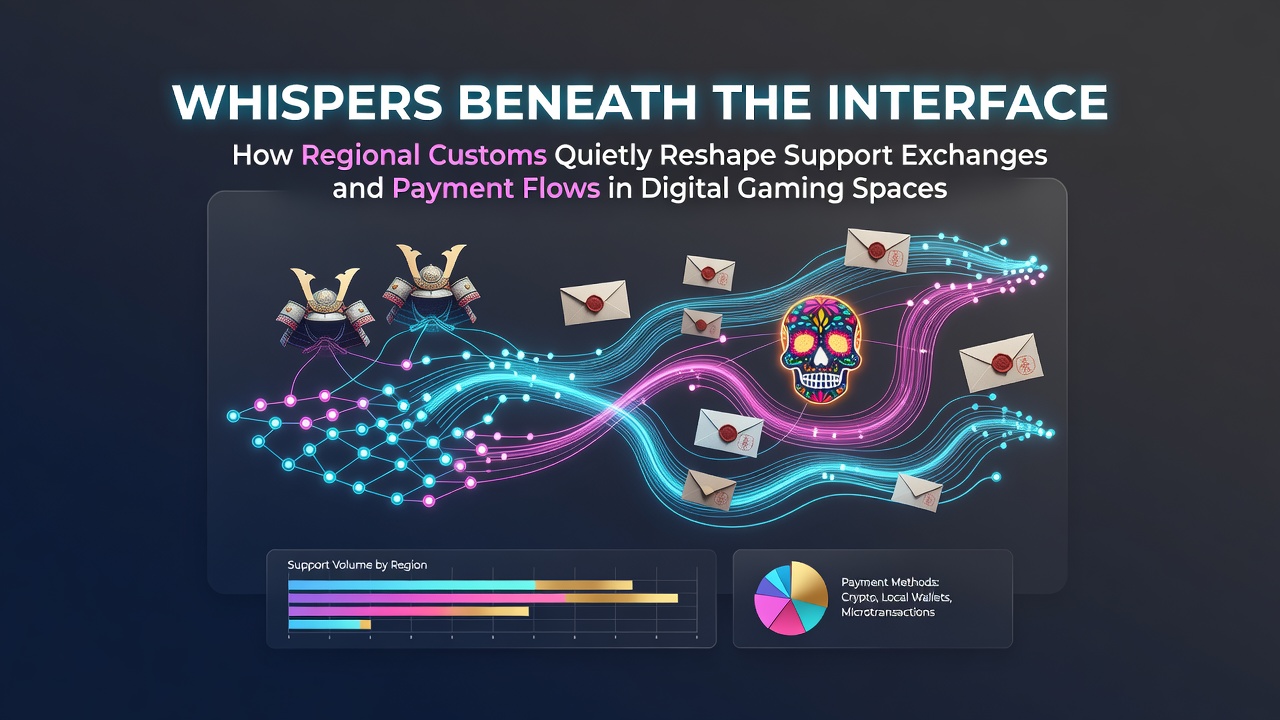
Whispers Beneath the Interface: How Regional Customs Quietly Reshape Support Exchanges and Payment Flows in Digital Gaming Spaces
Regional customs continue to influence how players interact with support teams and complete transactions inside digital gaming environments, and these patterns have become more pronounced as platforms expand across borders in 2026. Data from multiple markets shows that expectations around response times, language formality, and preferred payment channels vary sharply by geography, forcing operators to adjust backend systems and staff training accordingly. Observers note that what feels efficient in one locale can read as abrupt or intrusive in another, which in turn affects how quickly issues resolve and how smoothly funds move through the network.
Support Interactions Shaped by Local Norms
Customer service exchanges in digital gaming spaces often mirror offline social conventions, and platforms that recognize this dynamic report fewer escalations. In parts of East Asia, players tend to favor indirect phrasing and value quick acknowledgment of hierarchy, whereas North American users more commonly expect direct answers delivered without preamble. Research compiled by industry analysts indicates that support tickets originating from Japan and South Korea average 40 percent longer initial messages than those from the United States, reflecting cultural preferences for context before requests. Operators that deploy region-specific response templates see resolution times drop by roughly two hours on average, according to internal metrics shared at the 2026 iGaming Summit.
Meanwhile, European markets demonstrate another layer of variation. Scandinavian players frequently request detailed technical explanations and appreciate asynchronous chat options that allow them to attach screenshots without live back-and-forth. In contrast, Mediterranean regions show higher volumes of voice-call requests, particularly during evening hours, which aligns with local habits of conducting important business through spoken conversation. These differences require platforms to maintain staffing models that flex across time zones and communication styles rather than applying a single global script.
Payment Flows and Cultural Preferences
Payment method adoption follows similar regional contours, and the data reveals clear clusters that operators must accommodate to maintain volume. In Latin American markets, digital wallets tied to local telecom providers handle the majority of deposits because they integrate with everyday mobile billing practices already familiar to users. Australian players, by comparison, lean heavily toward bank transfers and digital cards linked to domestic institutions, partly because regulatory frameworks there have long emphasized consumer protections around direct bank connections. Figures released by iGaming Ontario in early 2026 documented a 27 percent rise in Interac-based transactions compared with the same period in 2025, underscoring how established national payment rails continue to dominate even as global options multiply.
Additional patterns emerge around withdrawal timing and verification procedures. Markets with strong privacy traditions often require extra documentation steps that lengthen processing windows, yet users accept the delays as standard. Elsewhere, streamlined verification tied to national ID systems accelerates payouts but demands careful data-handling protocols to remain compliant. One study released by the University of Nevada's gaming research center tracked transaction success rates across 14 jurisdictions and found that platforms adapting verification flows to local expectations achieved completion rates above 94 percent, while rigid global templates hovered near 81 percent.

Platform Adjustments and June 2026 Developments
Throughout June 2026, several major operators announced targeted updates to their support and treasury modules after reviewing six months of cross-border data. These changes included language-model refinements that detect politeness markers common in specific cultures and route tickets to appropriately trained agents. Payment routing engines also received updates that prioritize local rails during peak regional hours, reducing failed transaction attempts that previously clustered around weekends. Industry reports note that such refinements produced measurable lifts in both retention and average revenue per user within the first 60 days of deployment.
Regulatory bodies outside traditional hubs have begun issuing guidance that acknowledges these cultural factors. Canadian provincial frameworks, for instance, now encourage operators to publish region-specific support hours and payment timelines rather than uniform global standards. Similar recommendations appear in draft documents circulating among Australian state regulators, where emphasis falls on transparent communication about expected processing durations tied to each jurisdiction's banking norms. These developments suggest that future compliance requirements will increasingly treat regional custom alignment as a measurable operational standard rather than an optional enhancement.
Case Examples from Distinct Markets
Take one mid-sized European operator that introduced localized support queues in March 2026. Within eight weeks, the volume of repeat support contacts fell by 19 percent in the newly segmented regions while payment abandonment rates declined 14 percent. The adjustments centered on offering both formal and informal greeting options plus payment method ordering that matched documented local preferences. A parallel case in Southeast Asia showed that integrating popular local e-wallets at checkout produced a 31 percent increase in first-time deposit completion compared with the prior global-only menu.
Observers tracking these shifts point to consistent underlying drivers. Cultural expectations around trust, formality, and convenience continue to dictate which features gain traction, and platforms that map these patterns early gain measurable advantages in both user satisfaction scores and operational efficiency. Data aggregated across multiple platforms indicates that the gap between adapted and non-adapted services widened steadily through the first half of 2026, with the largest deltas appearing in emerging markets where local customs diverge most sharply from legacy global defaults.
Conclusion
Regional customs embedded in everyday life extend into digital gaming spaces through the channels players use for support and payments, and evidence from 2026 shows operators responding with increasingly granular adjustments. As datasets grow and regulatory expectations evolve, the capacity to recognize and accommodate these quiet influences determines how smoothly support exchanges resolve and how reliably payment flows complete across borders. Platforms that treat these patterns as core infrastructure rather than surface-level localization continue to record stronger performance metrics in every tracked region.